
The Marsupial and the Rat: A Delicate Coexistence in the Andean Forest

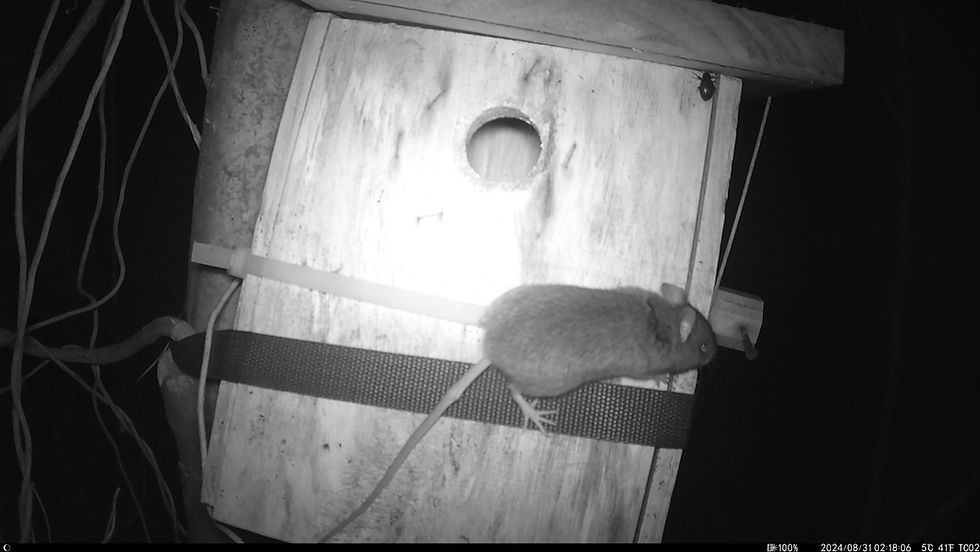
Research by Fernanda Barz Cabezas, Universidad de Chile, 2024
In the Andean temperate forests of Araucanía, one of the world's most ancient and unusual mammals goes about its nightly business largely unseen. The monito del monte — literally "little mountain monkey" — is a small marsupial no bigger than a mouse, with a prehensile tail and opposable thumbs that let it move through the forest canopy with remarkable agility. It is the sole surviving member of an ancient lineage that dates back to the time of Gondwana, making it a kind of living fossil. And it may be under threat from an unlikely rival: the black rat.
Fernanda Barz's research, carried out across three forest sites in the Pucón area — including Kodkod and Llancalil — set out to understand how these two very different animals interact when they share the same space. Specifically, she wanted to know whether the black rat, an invasive species that has spread widely through southern Chile, poses a real threat to the monito del monte by competing for the tree cavities both species use as shelter and nesting sites.
Ninety nest boxes were installed across the three sites and monitored with camera traps throughout the austral winter of 2023 — the most vulnerable season for the monito del monte, which enters a state of torpor during the coldest months, dramatically reducing its metabolism to survive the cold and food scarcity.
The results painted a nuanced picture. Black rats were detected at the two lower-elevation sites — Kodkod and Kawelluco — both of which are secondary forests close to human settlements. They were completely absent from Llancalil, the higher-elevation site with less human disturbance and a dense bamboo understorey. Intriguingly, the monito del monte thrived most at Llancalil, where its detection rate was nearly three times higher than at the disturbed lower sites.
In terms of direct conflict, the camera traps recorded no attacks or predation events. However, something subtler was happening. At the Kodkod site, where both species were present in roughly equal numbers, the monito del monte showed a measurable shift in its activity patterns — becoming active earlier in the evening than it did at Llancalil, where no rats were present. This suggests that even without open confrontation, the presence of rats is nudging the monito del monte to adjust its behaviour.
Perhaps the most striking finding was about what the monito del monte actually needs: steep slopes, dense bamboo understorey, and distance from human settlements. Slope, of all the variables measured, turned out to be the single strongest predictor of where monito del monte were most active. Steeper terrain tends to be further from houses and roads, richer in the bamboo that the species depends on for nesting material, and less hospitable to black rats, which follow humans into the landscape.
The research adds to a growing picture of how invasive species are quietly reshaping the dynamics of Araucanía's native forests — not always through dramatic predation, but through subtle pressures that slowly push native species to the margins. For places like Llancalil, which sits at higher elevation, free from human settlement and rich in bamboo, the message is clear: protecting these refuges is one of the most important things we can do for the remarkable and irreplaceable wildlife that depends on them.


Comentarios