
History written in the woods: reading the signs of the past in Parque Kodkod
Actualizado: 6 jun
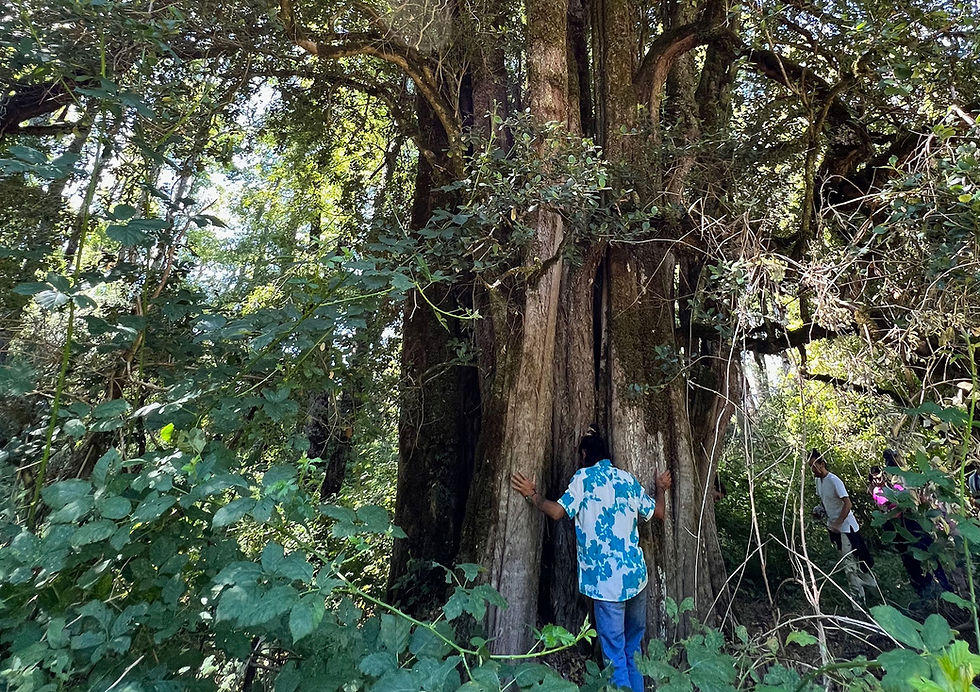
Based on a structural and historical study of the Kodkod Field Studies Center, 2025, by Ignacio Urrea, Pontificia Universidad Catolica de Chile.
What this study set out to do
This report reconstructs the history of the forest at the Kodkod Field Studies Center in Pichares, near Pucón, and describes its current ecological condition. The researchers used three approaches: historical documents and local interviews, tree ring analysis, and detailed field measurements of forest structure and composition across five sample plots.
A forest shaped by fire and logging
The Kodkod Park woodland has lived through centuries of disruption. Indigenous communities used fire to clear land long before European arrival. Spanish colonisation from the mid-1500s brought intensive logging, burning to clear military routes, and the introduction of livestock. The "Pacification of the Araucanía" in the late 1800s accelerated this transformation further, with soldiers axing their way through what contemporary accounts described as vast and ancient forests.
By the early twentieth century, the park fell within the Villarrica Forest Reserve, whose 1913 survey described roble (Nothofagus obliqua) as the dominant tree across the lower slopes — exactly where Kodkod sits today.
The single most decisive event in recent history, however, was a major wildfire in 1943–1944 that burned through most of the native forest. Local residents interviewed for this study recalled that when they were children the trees were still very small, and they played among the young shoots looking for edible fungi. After the fire, the largest surviving trees were logged for firewood and timber. The forest standing today grew almost entirely from that point.
What the tree rings revealed
A cross-section taken from a large roble southern beech tree felled in 2024 showed approximately 217 annual rings — meaning the tree established itself around 1807, well before the 1943 fire. This suggests that at least some individuals survived the blaze, likely in the lower valley where fire intensity was reduced. Within the same cross-section, additional growth rings consistent with an age of 80–87 years were found in what appear to be regrowth shoots — consistent with the tree surviving the fire and resprouting from its base, a known survival strategy of roble.
What the forest looks like today
The current forest is overwhelmingly dominated by roble, which accounts for roughly 86% of the total basal area across the five sample plots. Structurally, it is a dense stand — approximately 1,700 trees per hectare — with an average trunk diameter of around 16 centimetres. These are the characteristics of a forest in what ecologists call the "stem exclusion" phase: trees are growing rapidly and competing intensely with one another, but the canopy has not yet opened up enough to allow a rich understorey to re-establish.
In practical terms, this means the forest is young and vigorous but not yet structurally complex. Shade-tolerant species that characterise mature temperate forests — such as laurel, lingue, and olivillo — are present in the understorey but represent only a small fraction of the total canopy. Maqui (Aristotelia chilensis) is abundant in the lower layers, as it typically is in recovering forests.
Scattered across the lower valley, some large old individuals — both roble and laurel — show signs of internal decay consistent with great age. These are likely survivors of the 1943 fire and represent an irreplaceable biological legacy for the recovering ecosystem around them.
What this means for the future
The Kodkod forest is on a natural recovery trajectory, but it is still in an early phase. The key ecological task over coming decades is to support the transition toward a more structurally diverse forest — one with multiple canopy layers, a richer mix of species, and the complexity that supports greater biodiversity. Protecting the ancient surviving trees, monitoring the gradual establishment of shade-tolerant species, and avoiding any further disturbance to the lower valley — where the most ecologically significant remnants are concentrated — are the priorities that follow from this baseline study.


Comentarios