
Cavity-Nesting Birds and Forest Ecology in Andean Temperate Forests.

What twenty years of research at Kodkod has taught us about forests, birds, and the life inside decaying wood
Introduction
The Andean temperate forests of southern Chile constitute one of 35 recognised global biodiversity hotspots, characterised by high levels of endemism and an exceptionally cavity-dependent vertebrate community (Myers et al. 2000). A sustained programme of research centred on the Pucón region of the Araucanía — carried out principally by Tomás Altamirano, José Tomás Ibarra, Kathy Martin and colleagues — has generated a substantial and methodologically coherent body of work on the ecology of cavity-nesting birds and the forest structural processes that sustain them. This review synthesises key findings across four interrelated themes: the supply and distribution of tree cavities; the structure of cavity nest webs as complex adaptive systems; elevational variation in reproductive life-history traits; and the conservation implications of tree decay and old-growth forest loss.
1. Tree Cavity Supply: Old-Growth vs. Secondary Forests
A foundational question in cavity-nester ecology is whether the supply of suitable nesting sites limits breeding populations. Ibarra et al. (2020, Austral Ecology) directly addressed this question in Andean temperate forests by surveying 7,951 trees across ten forest stands — five old-growth (>200 years) and five secondary (40–80 years) — in the municipality of Pucón. Their results revealed striking structural differences between forest types. While live tree density was significantly higher in secondary forests, the density of cavity-bearing trees was 0.26 times greater in old-growth stands, where cavity trees represented 36% of all trees compared to 16% in secondary stands.
Critically, the density of non-excavated cavities — those formed by natural decay processes — was approximately twice as high in old-growth (352 ha⁻¹) than in secondary forests (176 ha⁻¹), whereas the density of excavated cavities did not differ significantly between forest types (~7–8 ha⁻¹). This asymmetry is ecologically significant given that approximately 75% of nests used by secondary cavity nesters in Andean temperate forests are located in non-excavated, decay-formed cavities (Altamirano et al. 2017, cited therein). Generalized linear mixed-effects models confirmed that tree diameter at breast height (DBH) and decay class were the strongest predictors of both cavity occurrence and abundance, with their combined effect more pronounced for non-excavated than excavated cavities. Long-dead trees (decay class 4) showed the highest probability of holding non-excavated cavities, even at relatively low DBH values, underscoring the ecological importance of standing dead trees (snags) as disproportionate contributors to cavity supply.
These findings position Andean old-growth forests as cavity-rich systems substantially above the global median cavity density of 16.2 ha⁻¹ reported by Remm and Lõhmus (2011), a pattern the authors attribute in part to the high rates of wood decay characteristic of Nothofagus-dominated forests under the combined action of wood-decay fungi, mistletoe infection, wind and drought. The authors conclude that while cavity supply is unlikely to be a limiting factor in old-growth stands, the eventual loss of legacy snags in secondary forests — as they reach advanced decay and fall — may precipitate a significant contraction in cavity availability, with consequences for multiple dependent vertebrate species.
2. Cavity Nest Webs as Complex Adaptive Systems
Ibarra et al. (2020, Ecology and Society) extended the conventional nest web framework — in which cavity flow is modelled as a hierarchical and largely commensal process from trees through excavators to secondary cavity nesters — by applying principles from complex systems science. Drawing on long-term datasets from four forest systems across the Americas (Chile, Canada, Argentina and Ecuador), the authors employed the panarchy framework of Gunderson and Holling (2002) to represent nest webs as adaptive cycles operating simultaneously at four nested spatial scales: the single cavity-tree, the community of cavity nesters, the landscape mosaic of nest webs, and the regional distribution of nest web landscapes.
The analysis identified five properties of nest webs as complex adaptive systems: redundancy, heterogeneity, memory, uncertainty, and nonlinearity. In the south temperate forest of Chile specifically, species redundancy among excavators is notably low — only four excavator species produce cavities, with minimal size overlap — compared to the high redundancy systems of Canada, Argentina and Ecuador (12–17 excavator species). This restricted niche availability for secondary cavity nesters suggests lower inherent resilience of Chilean nest webs to perturbation. Memory — defined as the legacy of historical events that continues to influence compositional and functional states — is embodied in large old trees, persistent cavities, and the mycorrhizal networks that connect cavity-tree recruitment across generations. The authors demonstrate that nonlinear responses to disturbance are well documented: selective logging that removed half the basal area of subtropical forests in Argentina resulted in nine times fewer cavities and 17 times fewer nests than in old-growth areas.
This synthesis provides a theoretical grounding for management recommendations, emphasising the need to maintain structural heterogeneity and habitat memory — particularly the retention of large old trees and snags — as mechanisms that buffer nest web systems against regime shifts. The authors argue that current forest policies in Chile and Argentina, which simultaneously promote large-scale monoculture plantations and permit high-grade selective logging of the largest living trees, are fundamentally incompatible with sustaining nest web resilience.
The role of tree decay as the primary mechanism organising cavity availability in Andean temperate forests was further elaborated in a prior synthesis (Altamirano et al. 2012, summarised in La Chiricoca no. 15), which established that 69% of cavities used by birds, small mammals and reptiles in the Andean forest are non-excavated, contrasting markedly with the situation in interior British Columbia where 90% of secondary cavity nesters use excavated cavities. The comesebo grande (Pygarrhichas albogularis) rather than woodpeckers was identified as the most important excavator in this system, with its cavities strongly preferred by Chilean swallows (Tachycineta meyeni), while woodpecker cavities were used by austral parakeets (Enicognathus ferrugineus) and the Rufous-legged Owl (Strix rufipes) — a species of high conservation priority in southern South American forests.
3. Reproductive Life-History Variation Across Elevational Gradients
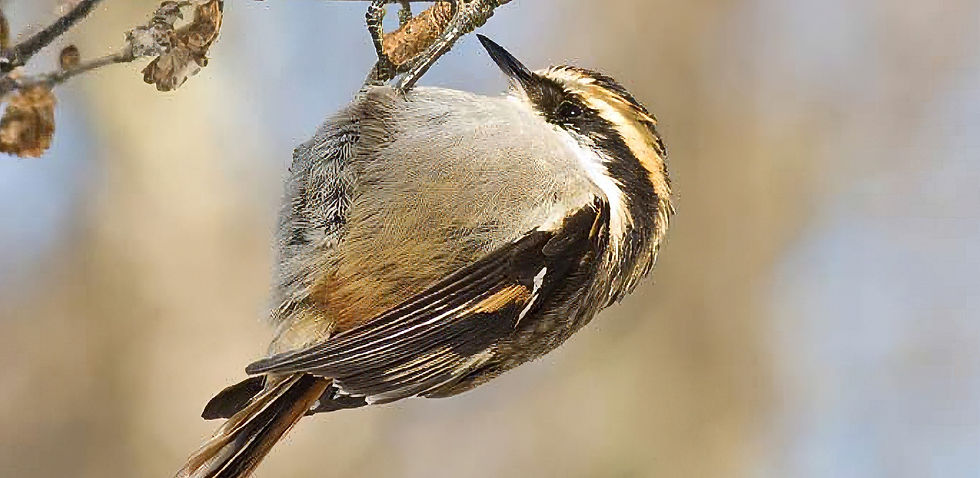
Altamirano et al. (2015, The Auk) provided the first assessment of elevational variation in reproductive life-history traits for a cavity-nesting bird in South American temperate forests, using the Thorn-tailed Rayadito (Aphrastura spinicauda) as a model species. Across six study sites ranging from 260 to 1,115 m elevation near Pucón, 240 nest-boxes were deployed and 162 nests monitored over two breeding seasons (2010–2012), with a further 50 nests included for clutch-size analysis in a third season.
Results were consistent with the fast–slow continuum model of life-history variation: birds at higher elevations showed smaller clutch sizes (mean 4.1 vs. 4.5 eggs), fewer nestlings per clutch (3.5 vs. 4.2), a breeding season 28–55% shorter than at low elevations, and a marginally but significantly longer nestling period (22.3 vs. 21.7 days). Notably, incubation period did not vary with elevation. Nesting success was substantially lower at high elevations, with only 16% of nests fully successful compared to 42% at low elevations, a pattern driven primarily by predation — accounting for 84% of nest failures in highland forests during the second breeding season. No second nesting attempts were recorded at high elevation, further indicating a shift toward a slower reproductive strategy.
These findings parallel patterns documented in northern temperate systems and extend the fast–slow continuum framework to the southern hemisphere. However, the authors note that the apparent shift toward a slower strategy — smaller clutches, extended nestling periods — does not appear to compensate for elevated predation rates in highland forests, questioning the adaptive significance of this response. The study also revealed important differences from coastal populations of the same species reported at lower latitudes, with Andean birds showing larger clutch sizes than predicted by latitude alone, highlighting the interacting effects of elevation and latitude as drivers of life-history variation.
4. Conservation Implications
Across this body of work, several conservation conclusions recur with consistency. First, old-growth forest stands are irreplaceable reservoirs of non-excavated cavity supply, and their loss — whether through logging, fire suppression failure, or plantation expansion — will have nonlinear, lagged consequences for the diverse vertebrate assemblage dependent on this resource. Second, standing dead trees and large decaying trees in both old-growth and secondary forests constitute keystone habitat elements that warrant explicit protection; their routine removal for firewood or perceived forest hygiene represents a poorly appreciated but significant conservation risk. Third, the low excavator redundancy of Chilean temperate forests reduces the capacity of the nest web to buffer disturbance, making retention of diverse decay classes and tree size cohorts particularly important for long-term resilience. Fourth, elevational gradients impose significant constraints on reproductive output, with highland populations of cavity nesters facing higher predation pressure and shorter breeding seasons — characteristics that reduce population recovery capacity and increase vulnerability to habitat degradation.
References
Altamirano, T.A., Ibarra, J.T., de la Maza, M., Navarrete, S.A. & Bonacic, C. (2015). Reproductive life-history variation in a secondary cavity-nester across an elevational gradient in Andean temperate ecosystems. The Auk: Ornithological Advances, 132(4), 826–835.
Altamirano, T.A., Ibarra, J.T., Martin, K. & Bonacic, C. (2012). Árboles viejos y muertos en pie: un recurso vital para la fauna del bosque templado de Chile. La Chiricoca, 15, 25–30.
Ibarra, J.T., Cockle, K.L., Altamirano, T.A., Van der Hoek, Y., Simard, S.W., Bonacic, C. & Martin, K. (2020). Nurturing resilient forest biodiversity: nest webs as complex adaptive systems. Ecology and Society, 25(2), 27.
Ibarra, J.T., Novoa, F.J., Jaillard, H. & Altamirano, T.A. (2020). Large trees and decay: suppliers of a keystone resource for cavity-using wildlife in old-growth and secondary Andean temperate forests. Austral Ecology, 45, 1167–1176.


Comentarios